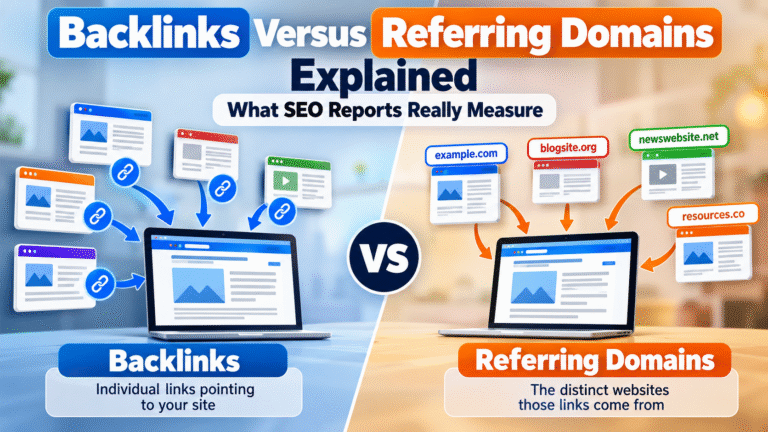
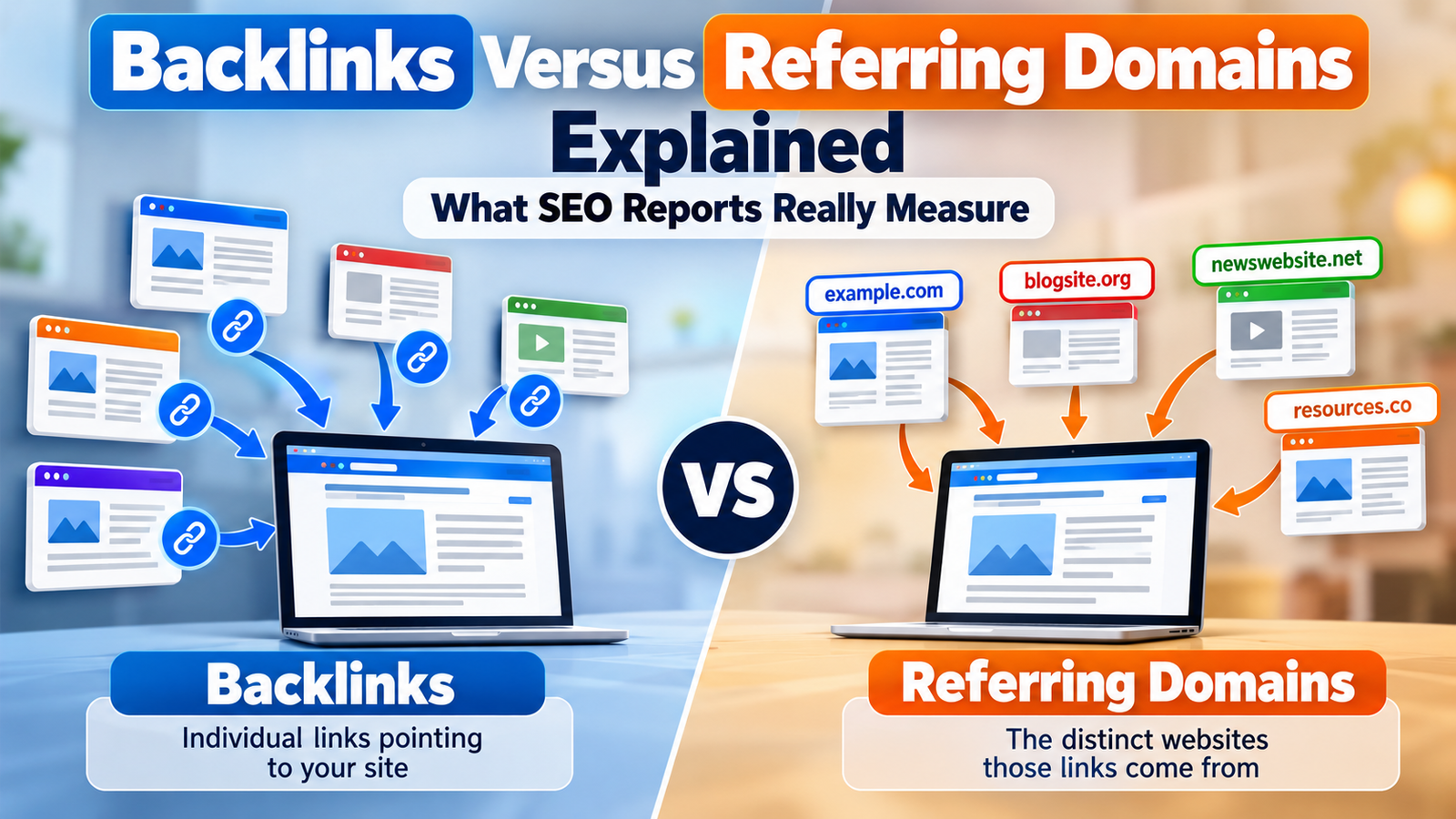
Backlinks versus referring domains explained in plain English: backlinks are individual links pointing to your site, while referring domains are the distinct websites those links come from. The difference matters when you assess a site’s authority, compare competitors or decide whether a link-building campaign is working. A large backlink count can look impressive, but it does not automatically mean that many independent websites trust your content.
What counts as a backlink?
A backlink is a hyperlink on another website that leads to a page on yours. If a photography blog links to your guide in three separate articles, those are usually counted as three backlinks. Search tools may also report links from different pages on the same site, links in navigation or footers, and links that use different anchor text.
Not every backlink carries the same value. A relevant link placed in the body of a useful article may send interested readers and help search engines understand the relationship between the pages. A repeated sitewide link, an unrelated directory entry or a link from a low-quality page may contribute less. Counts are useful, but context is what helps explain them.
What is a referring domain?
A referring domain is a unique website that links to you. In the example above, the photography blog counts as one referring domain, even though it provided three backlinks. If another site links to the same page, your totals become four backlinks from two referring domains.
This distinction gives you two different measures. Backlinks show the volume of links. Referring domains show how many separate sites have chosen to link to you. Neither figure is a complete measure of quality, but together they provide a more useful starting point than either one alone.
Why the distinction changes how you read SEO data
Imagine two businesses with 500 backlinks each. One has links from 20 websites, many of which link repeatedly from every page. The other has links from 300 different websites, each mentioning a useful resource once. The totals are identical, but the link profiles tell different stories. The first may have a few strong relationships or a large amount of sitewide repetition; the second shows broader coverage, though each link still needs to be assessed for relevance and quality.
That is why it helps to look at backlink and referring-domain trends together. If backlinks rise sharply but referring domains barely change, existing sites may simply be linking to you more often. If both rise, new websites are discovering your material. A sudden increase in either number is not automatically good or bad: check where the links came from, which pages they point to, and whether the growth looks natural.
Use both measures in competitor research
Competitor analysis is most useful when it reveals opportunities, not when it turns into a race to copy the biggest number. Start by comparing websites that target a similar audience and search intent. Look at the pages attracting links, the subjects they cover, and the kinds of sites that cite them. A competitor may earn links because it publishes original research, a practical template or a clear explanation that other writers find useful.
Then check whether those linking sites could also be relevant to your own work. A link opportunity is not worthwhile merely because a competitor has it. Your page should offer a credible reason for another publisher to cite it, such as more current information, a different dataset or a useful resource for that publisher’s readers. For a structured workflow, this guide to competitor backlink analysis can help organise the research and identify practical next steps.
Build link-worthy pages, not just link totals
Before contacting publishers, make sure the destination page deserves attention. It should answer a real question, present information clearly and offer something distinct from the pages already ranking. Keep a record of the referring domain, the linked page, the reason it may be relevant and any outreach you make. This makes it easier to spot patterns and avoid contacting the same publication repeatedly.
Useful assets can take many forms. A business selling handmade furniture, for example, might publish a detailed materials guide, a room-planning resource or strong product photography. Visual quality matters in industries where buyers need to judge finish, colour and detail before making a decision. That also raises a practical question for online sellers: can AI replace product photographers? AI tools can help with background edits, concepts and routine variations, but real product images are often important when accuracy, texture and faithful representation matter. Businesses weighing up the options can compare photography rates by shoot type and consider what a project needs before setting a budget. Osdire, for instance, lists freelance services across photography and other categories, giving buyers a way to explore different kinds of creative support.
Read the numbers in context
Backlinks and referring domains answer related but different questions: how many links exist, and how many separate sites provide them? Track both, examine the pages and publishers behind the figures, and judge progress by relevance and usefulness rather than raw volume. A smaller set of well-matched links can be more meaningful than a much larger count built from repetition. The aim is not simply to reproduce a competitor’s profile, but to create pages that give other websites a genuine reason to link to you.
About the Author